Locked Drawer, Full Heart: The Secret Architecture of the American Snack Bunker
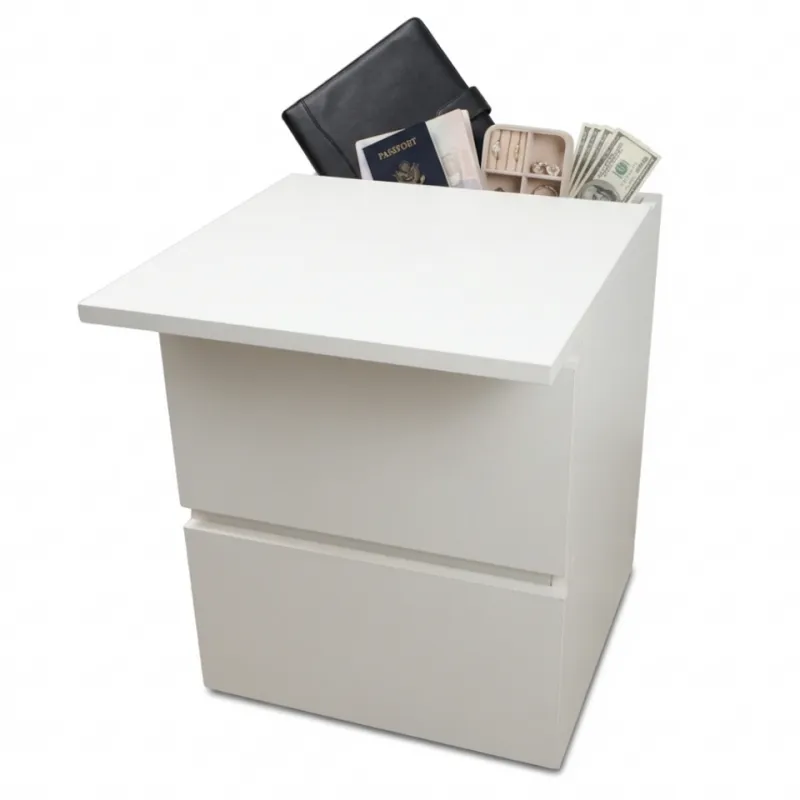
Photo: FurnitureSecurityEU, CC BY 4.0, via Wikimedia Commons
Somewhere in a cubicle farm outside Columbus, Ohio, a middle-aged account manager named Denise is guarding a stash of peanut M&Ms with the intensity of a woman protecting nuclear launch codes. The M&Ms are behind a box of tax forms. The tax forms are behind a decorative succulent. The succulent is a decoy. Nothing in Denise's workspace is what it appears to be, and that is exactly how she wants it.
"If they can see the candy, they'll take the candy," she told Dogboff over a phone call she asked us to keep vague. "My drawer has layers. It's like an onion. A delicious, protected onion."
Denise is not alone. She is one of millions of Americans operating what internet communities have come to call a Snack Bunker: a deliberately concealed, strategically fortified cache of food hidden from coworkers, roommates, siblings, and in at least one case we heard about, a very determined father-in-law.
The Rise of the Bunker Economy
Ask around any American office and you'll find them. The desk drawer that opens with a slight squeak and reveals nothing — until you pull the false bottom. The mini-fridge in the shared kitchen where a Greek yogurt sits labeled "DAD" even though nobody named Dad works there. The tote bag hanging on the back of a chair that contains, according to one source, "enough Clif Bars to survive a winter."
This isn't just snacking. It's infrastructure.
Reddit threads and TikTok hashtags dedicated to hidden snack stashes have racked up millions of views, with users showing off setups that range from modest (a sleeve of crackers under a keyboard) to genuinely alarming (a full pantry shelving unit disguised as a filing cabinet). One viral video from last year featured a woman in Phoenix who converted a hollowed-out dictionary into a Twinkie vault. The comments section, naturally, devolved into a heated debate over whether Twinkies were worth the effort. (They are. This is not up for debate.)
The escalation is real. What starts as a bag of chips becomes a drawer organizer becomes a lockbox becomes, for one man in suburban Detroit, a fake electrical outlet cover purchased from a novelty spy shop, behind which lives an estimated four pounds of beef jerky.
"My wife thinks I'm insane," he admitted. "My wife also has never once found the jerky. So who's really insane here?"
Desk Drawer Diplomacy
The bunker exists because of a simple, universal truth: shared food is a myth. The moment your snacks enter a communal space, they enter the public domain. You bought the good granola bars? They're gone by Tuesday. That fancy dark chocolate you were saving? Someone microwaved it for s'mores and didn't even say thank you.
Every bunker builder we spoke to had a defining betrayal story. A roommate who ate a clearly labeled leftover and replaced it with the same container, refilled with something cheaper. A coworker who took a single bite out of every pastry in the break room "to see which one was best." A sibling who, decades later, still denies the Great Fruit Rollup Heist of 2009.
"People say, 'why not just ask people not to eat your stuff?'" says one bunker architect who works in a Chicago open-plan office. "Because I tried that. I put my name on things. I put a NOTE on things. You know what a note is in an office? It's a dare."
The Gallery of Great Fortifications
We asked the internet to submit their most elaborate setups, and the internet delivered like a DoorDash driver with a death wish:
- The False Bottom Classic — A desk drawer with a cut-to-fit cardboard insert hiding two layers of snacks beneath. Timeless. Reliable. The Honda Civic of bunkers.
- The Decoy Container — A folder labeled "Q3 EXPENSE REPORTS" containing zero expense reports and one family-size bag of Doritos. Genius in its boringness.
- The Mini-Fridge Bait Operation — A fridge containing one sad, clearly visible yogurt, while the actual goods live in a cooler bag inside a filing cabinet. Psychological warfare.
- The Bunker Within a Bunker — A stash hidden inside a larger stash, so that even if the outer layer is discovered, the intruder walks away with only the emergency rice cakes. Contingency planning at its finest.
- The Under-the-Bed Vault (Roommate Division) — A plastic storage bin with a combination lock, buried beneath a comforter so aggressively ugly no one would ever look under it.
Is Any of This Healthy? Absolutely Not. Will We Stop? Also No.
Look, we're not going to pretend this is a normal way to live. Hoarding snack-size Snickers behind a decorative rock is not a personality. But there's something deeply American about it — the rugged individualism, the distrust of the collective, the belief that with enough cardboard and deception, a person can hold onto what's theirs.
The bunker builders aren't angry people. They're not villains. They're just folks who learned, the hard way, that the break room is the jungle and the jungle does not negotiate.
So the next time you pass a coworker's desk and notice the suspiciously clean top surface, the single decorative plant, the drawer that sticks just a little — show some respect. You're not looking at a desk. You're looking at a fortress.
And if anyone asks, this article was about expense reports.